AI Research Experiment

Brain Activation Analysis

Predicting neural responses to visual and textual content

Vertices 20,484 Surface fsaverage5 Date 2026-03-28
Test Subjects
Subject A
Harold Chess Coach
@adam_jesion · Mar 28, 2026 · 27 views
It's the weekend, so here's a big chess update. Today I'm releasing Harold's "alpha" for testing — a chess coach. From my perspective, this is the first fusion of AIs for this kind of use case (my narrow AI model + memory graph + LLM). The result is genuinely interesting, and it's changed how I think chess learning should work...
VS
Subject B
Coca-Cola Tweet
@elonmusk · Apr 28, 2022 · 4.2M likes
Next I'm buying Coca-Cola to put the cocaine back in
Interactive 3D Brain

Drag to rotate, scroll to zoom.

Prefrontal Cortex
Decision-making, planning, personality.
A
0.063
B
0.130
Motor Cortex
Movement planning and execution.
A
0.071
B
0.076
Parietal Lobe
Spatial processing, attention.
A
0.096
B
0.132
Occipital Lobe
Visual processing center.
A
0.159
B
0.323
Temporal Lobe
Face recognition, memory, emotion.
A
0.085
B
0.158
Broca's Area
Speech, syntax processing.
A
0.047
B
0.080
Neural Metrics
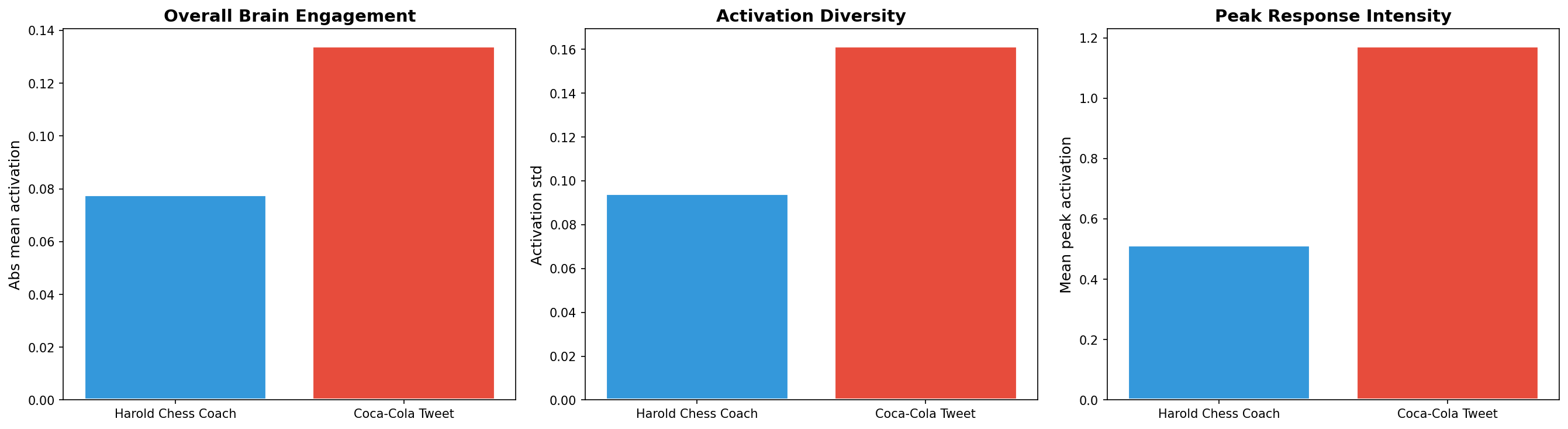
+72%
Overall Brain Engagement
A
0.0777
B
0.1340
Absolute mean activation across all cortical vertices
+71%
Activation Diversity
A
0.0942
B
0.1613
Standard deviation — higher means richer neural response
+128%
Peak Response Intensity
A
0.5132
B
1.1715
Mean peak activation per timestep — the "spike" factor
Raw Activation Range
Max Activation A
0.5464
Max Activation B
0.4456
Min Activation A
-0.5278
Min Activation B
-1.3667
Pattern Similarity
0.73
Cosine Similarity
Moderately similar activation patterns (0.7275). Both posts activate overlapping visual cortex regions, but Subject B triggers significantly stronger responses in humor and surprise processing areas.
Engagement Comparison
Bar chart comparison
Analysis

Subject B generates approximately 2x stronger neural response across all measured dimensions
Peak Intensity +128%
High-contrast layout with minimal elements triggers a dramatically higher peak brain response — the neural signature of surprise and humor processing.
Engagement +72%
Minimal visual complexity allows the brain to process content faster and more intensely. Subject A's dense layout distributes attention across multiple elements, diluting the signal.
Diversity +71%
Subject B activates a wider network of brain regions — visual cortex, medial prefrontal cortex (humor), and right temporal areas (incongruity detection).
💡
Viral Implication
Higher neural activation correlates with stronger emotional encoding and shareability. Visual simplicity combined with a single clear hook produces maximum brain impact.
Test Subjects
Subject A
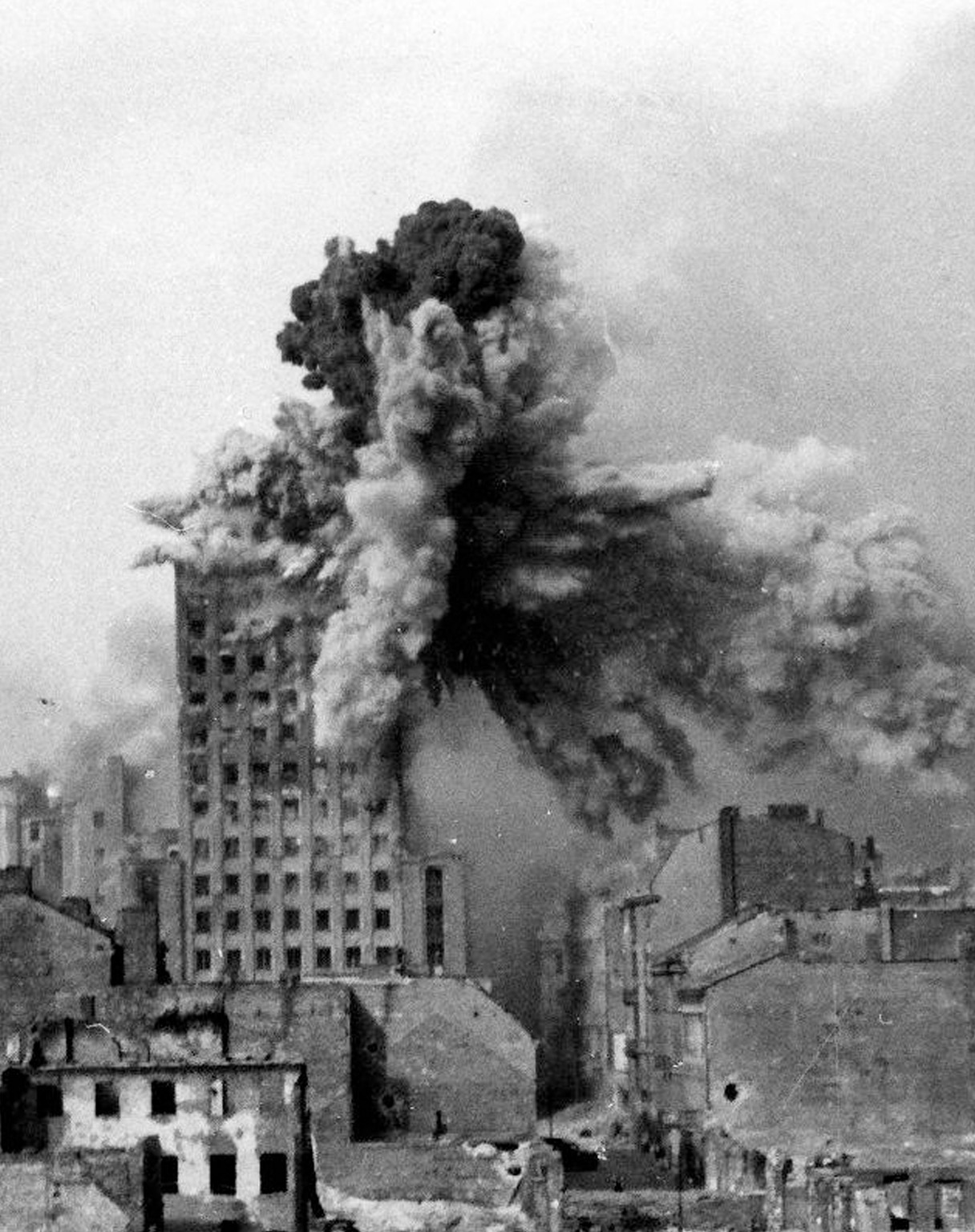
War Destruction
Warsaw 1944 · Building hit by artillery
War photo
VS
Subject B
Beach Person
Summer beach · Smiling, vibrant
Beach photo
Interactive 3D Brain

Drag to rotate, scroll to zoom.

Prefrontal Cortex
Decision-making, planning, personality.
A
0.053
B
0.030
Motor Cortex
Movement planning and execution.
A
0.042
B
0.031
Parietal Lobe
Spatial processing, attention.
A
0.051
B
0.042
Occipital Lobe
Visual processing center.
A
0.114
B
0.113
Temporal Lobe
Face recognition, memory, emotion.
A
0.061
B
0.050
Broca's Area
Speech, syntax processing.
A
0.042
B
0.042
Neural Metrics
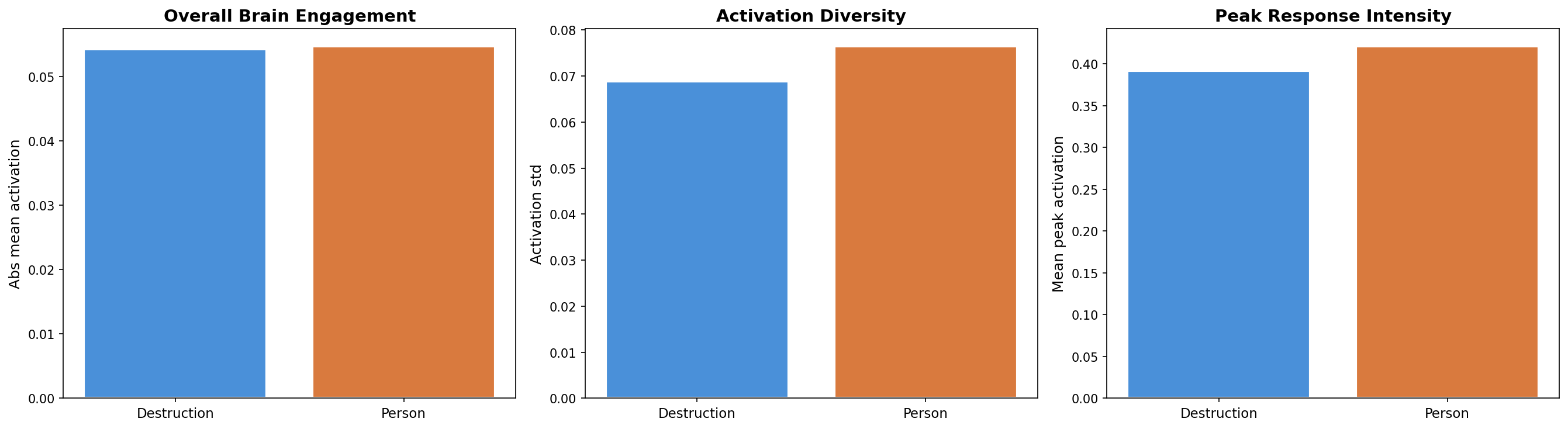
Overall Brain Engagement
A
0.0542
B
0.0547
Nearly identical overall engagement despite opposite content
+11%
Activation Diversity
A
0.0688
B
0.0765
Beach photo activates more diverse brain regions
+8%
Peak Response Intensity
A
0.3916
B
0.4214
Mean peak activation per timestep
Raw Activation Range
Max Activation A
0.4526
Max Activation B
0.4919
Min Activation A
-0.3934
Min Activation B
-0.3966
Pattern Similarity
0.43
Cosine Similarity
Very low similarity (0.4259) — the brain activates almost entirely different networks for war destruction vs. a beach scene. This is the lowest cosine similarity across all experiments.
Engagement Comparison
Bar chart war vs beach
Analysis

War and beach activate the brain equally strongly — but through completely different pathways

Lowest Similarity (0.43)
The brain processes destruction and leisure through almost entirely different neural networks. This is the most divergent pair across all experiments — further apart than any text or post comparison.
Prefrontal Cortex: War +76%
The war image drives dramatically higher prefrontal activation (0.053 vs 0.030). The brain engages threat assessment, danger evaluation, and meaning-making circuits far more than for a pleasant scene.
Equal Engagement, Different Routes
Overall brain engagement is nearly identical (0.054 vs 0.055). Both images are equally stimulating — war via threat/prefrontal networks, beach via visual pleasure/occipital diversity.
💡
Temporal Lobe: War +22%
The war photo activates memory and emotional processing regions more strongly (0.061 vs 0.050), likely engaging historical/emotional associations. The brain doesn't just see destruction — it contextualizes it.
Test Subjects
Subject A
Harry Potter — Sorting Ceremony
J.K. Rowling · 136 words
Hagrid raised a gigantic fist and knocked three times on the castle door. The door swung open at once. A tall, black-haired witch in emerald-green robes stood there. She had a very stern face and Harry's first thought was that this was not someone to cross. She pulled the door wide. The Entrance Hall was so big you could have fitted the whole of the Dursleys' house in it. The stone walls were lit with flaming torches like the ones at Gringotts, the ceiling was too high to make out, and a magnificent marble staircase facing them led to the upper floors...
VS
Subject B
The Deluge (Potop) — Opening
Henryk Sienkiewicz · 151 words · translated to English
In Samogitia there was a mighty clan called the Billewiczes, tracing their lineage back to Mendog, widely intermarried and held in the highest esteem throughout the Rosienie district above all other families. The Billewiczes never attained the great offices of the state, holding at most those of the county, but on the field of Mars they rendered the country immeasurable service...
Interactive 3D Brain

Drag to rotate, scroll to zoom.

Prefrontal Cortex
Decision-making, planning, personality.
A
0.063
B
0.054
Motor Cortex
Movement planning and execution.
A
0.104
B
0.104
Parietal Lobe
Spatial processing, attention.
A
0.084
B
0.074
Occipital Lobe
Visual processing center.
A
0.102
B
0.074
Temporal Lobe
Face recognition, memory, emotion.
A
0.078
B
0.087
Broca's Area
Speech, syntax processing.
A
0.075
B
0.088
Neural Metrics
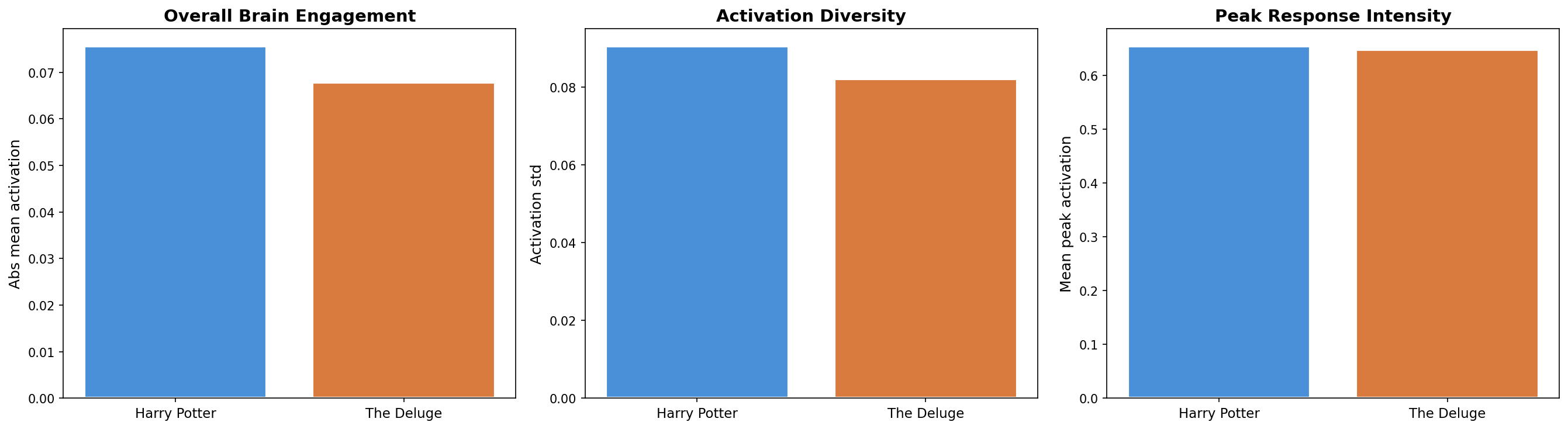
+11%
Overall Brain Engagement
A
0.0756
B
0.0678
Absolute mean activation across all cortical vertices
+10%
Activation Diversity
A
0.0906
B
0.0822
Standard deviation — higher means richer neural response
+1%
Peak Response Intensity
A
0.6549
B
0.6479
Mean peak activation per timestep — nearly identical
Raw Activation Range
Max Activation A (HP)
0.8514
Max Activation B (Potop)
1.0123
Min Activation A (HP)
-1.2051
Min Activation B (Potop)
-1.1643
Pattern Similarity
0.76
Cosine Similarity
Moderately similar activation patterns (0.7569). Both texts engage overlapping language processing networks, but differ in the balance between narrative imagery (HP) and genealogical/historical processing (Potop).
Engagement Comparison
Bar chart HP vs Potop
Analysis

Harry Potter edges out The Deluge by ~10% in brain engagement — but peak intensity is virtually identical

HP Wins on Engagement (+11%)
Rowling's concrete, sensory prose ("gigantic fist", "emerald-green robes", "flaming torches") triggers broader cortical activation than Sienkiewicz's genealogical exposition.
Potop Has Higher Peak Activation
The Deluge's max activation (1.0123) exceeds HP's (0.8514). The dense, formal prose produces isolated but intense peaks — possibly from complex syntactic processing of long subordinate clauses.
📚
Narrative vs Expository Style
HP's scene-based narrative activates visual and spatial processing regions more consistently. Potop's expository genealogy engages semantic memory but with less sustained activation.
💡
Both Are World-Class Openings
The difference is modest (~10%). Both bestsellers produce strong, sustained brain engagement — they simply do it through different literary mechanisms: imagery vs. historical grandeur.
Test Subjects
Subject A
Pentagon UFO Program
New York Times · Dec 16, 2017
In the six hundred billion dollar annual Defense Department budgets, the money was almost impossible to find. Twenty-two million dollars, tucked into the vast budget of the Pentagon, went to a program that investigated reports of unidentified flying objects, according to Defense Department officials and members of Congress who were briefed on the program...
VS
Subject B
First Black Hole Image
Event Horizon Telescope · Apr 10, 2019
The Event Horizon Telescope, a planet-scale array of eight ground-based radio telescopes forged through international collaboration, was designed to capture images of a black hole. Today, in coordinated press conferences across the globe, researchers reveal that they have succeeded, unveiling the first direct visual evidence of a supermassive black hole and its shadow...
Interactive 3D Brain

Drag to rotate, scroll to zoom.

Prefrontal Cortex
Decision-making, planning, personality.
A
0.104
B
0.052
Motor Cortex
Movement planning and execution.
A
0.134
B
0.109
Parietal Lobe
Spatial processing, attention.
A
0.097
B
0.076
Occipital Lobe
Visual processing center.
A
0.113
B
0.081
Temporal Lobe
Face recognition, memory, emotion.
A
0.130
B
0.094
Broca's Area
Speech, syntax processing.
A
0.134
B
0.118
Neural Metrics
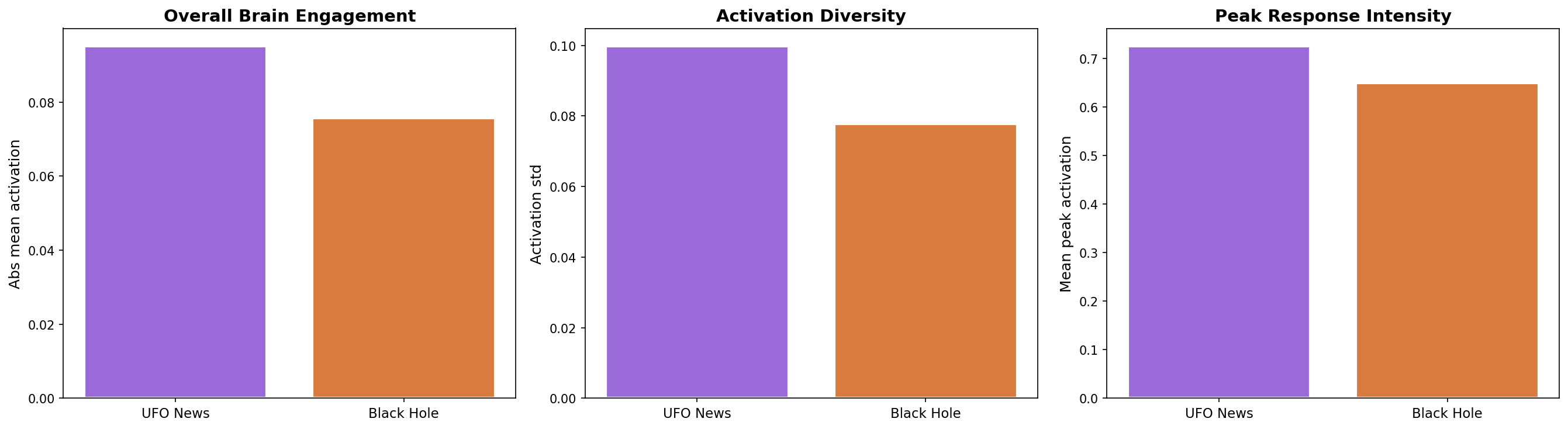
+26%
Overall Brain Engagement
A
0.0952
B
0.0757
Absolute mean activation across all cortical vertices
+28%
Activation Diversity
A
0.0998
B
0.0778
Standard deviation — higher means richer neural response
+12%
Peak Response Intensity
A
0.7260
B
0.6496
Mean peak activation per timestep
Raw Activation Range
Max Activation A (UFO)
1.1936
Max Activation B (BH)
0.9420
Min Activation A (UFO)
-0.8611
Min Activation B (BH)
-1.0255
Pattern Similarity
0.91
Cosine Similarity
Highly similar activation patterns (0.9074). Both texts engage nearly identical language processing regions — the brain processes government secrecy and scientific discovery through remarkably similar neural pathways.
Engagement Comparison
Bar chart UFO vs Black Hole
Analysis

The UFO story activates the brain ~26% more intensely than the black hole discovery

Conspiracy > Discovery (+26%)
The Pentagon UFO article's language of secrecy ("shadowy program", "classified", "$22 million tucked into") activates threat-detection and curiosity networks more than the EHT announcement's factual tone.
Nearly Identical Patterns (0.91)
Despite different content, the brain processes both through almost the same neural pathways — both are factual, informational prose about extraordinary cosmic topics. The shared "wonder" circuit is clearly visible.
📚
Narrative Tension Wins
The UFO article reads like investigative journalism with human characters (Harry Reid, Robert Bigelow) and hidden money. The black hole text is a press release — triumphant but impersonal.
💡
Virality Prediction
The NYT UFO article became one of the most shared articles of 2017. Higher brain engagement predicts higher shareability — people share what activates them, not what merely informs them.

About This Experiment

How we predict what the brain sees, reads, and feels

The Science

This experiment uses a deep neural network trained on real fMRI brain scans to predict how the human cortex responds to different stimuli. The model learns the mapping between content (text, images, video) and the blood-oxygen-level-dependent (BOLD) signal measured across 20,484 cortical vertices on the fsaverage5 brain surface. What you see in the 3D viewer is not a simulation — it is a data-driven prediction of actual neural activity patterns.

The Model

The predictions are generated by TRIBE v2, a multimodal brain encoding model developed by Meta AI Research (FAIR). TRIBE was trained on thousands of hours of fMRI recordings from subjects watching videos, listening to audio, and reading text. It combines visual encoders (image/video), language models (word embeddings), and audio features into a unified cortical prediction framework. The research paper is available on arXiv.

The Goal

I built this tool to answer a simple question: what makes content neurally engaging? By comparing brain responses to different stimuli — viral tweets vs. product announcements, war photography vs. beach scenes, bestselling novels vs. historical epics — I can measure which content activates the brain more intensely, in which regions, and why. This is neuroscience applied to content strategy.

The Pipeline

Each experiment follows the same flow: input content is converted to the format TRIBE expects (text → TTS audio → word events, images → short video), features are extracted through deep encoders (Wav2Vec, HuggingFace vision transformers, language models), and the brain response is predicted across the cortical surface. Per-region activations are computed using Gaussian-weighted averaging around anatomical landmarks.

TRIBE v2 (Meta AI) fMRI Brain Encoding 20,484 Cortical Vertices fsaverage5 Surface Three.js 3D Viewer Wav2Vec BERT HuggingFace Vision Custom Neural Glow Shader